
Finding Your 16 Year Old Self Will Revive Your Creativity
For all of us who feel lost and overwhelmed...

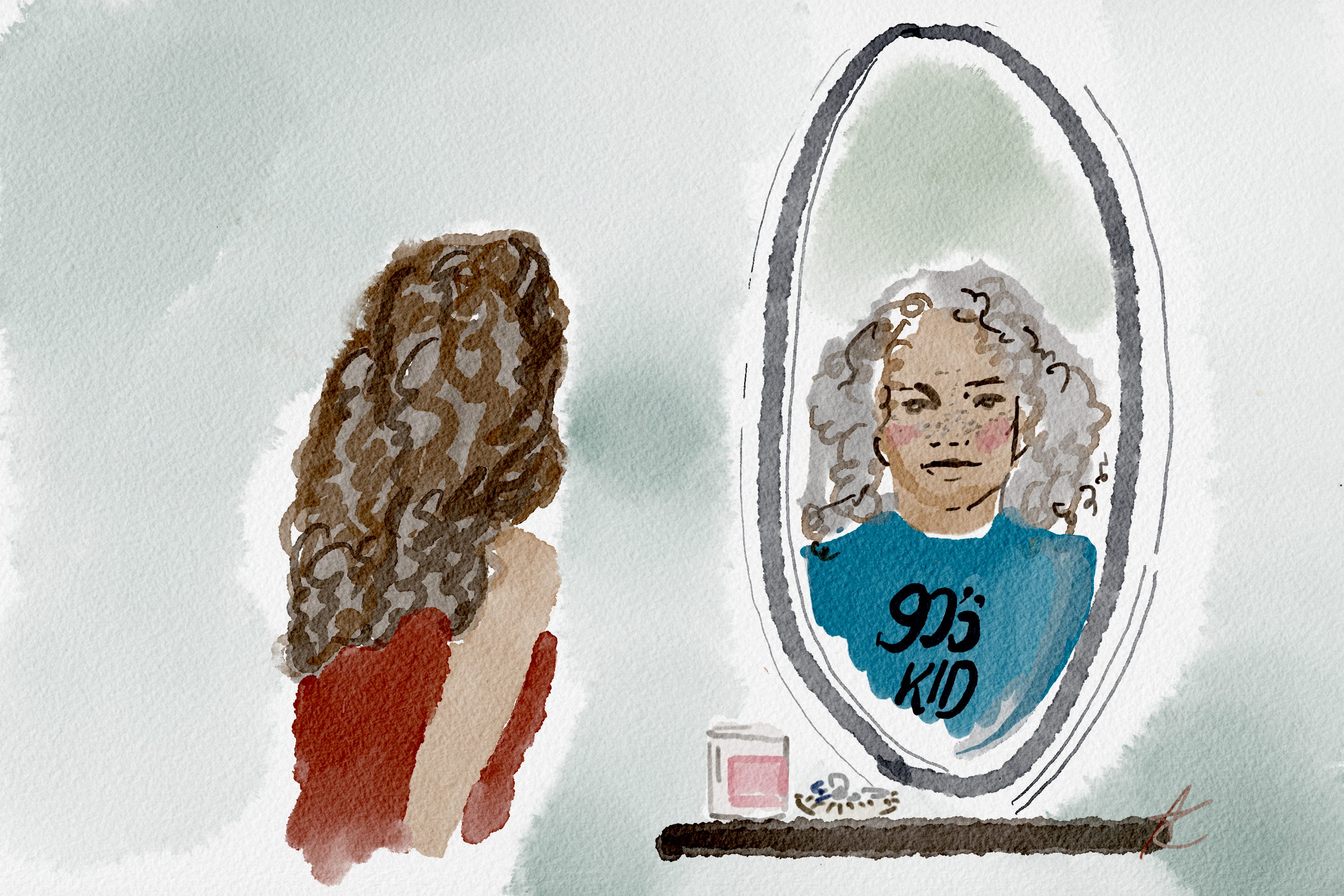
“Am I depressed or is this ADHD burn out?” I find myself typing into my phone. I look around for any prying eyes on the train. The coast is clear. I click on one of the top hits and fill out a quiz. Three minutes later and according to the website, my biggest red flag is that I’ve been crying everyday for weeks. Not unheard of for me. The result: inconclusive.
Exasperated, I lock the screen and sit back in my seat. Over the last year, I’ve undergone somewhat of a radical life awakening. To put it lightly, a relentless series of very unfortunate personal and professional events followed one another with little respite. None of it seemed to be in my control. It got so bad that a friend gave me the number of her priest.
Perhaps misguided, I held this belief that after a certain stage of life and career, what you may know as ‘proving your worth’, things would stabilise. The path towards The Future would feel more stable - or so I thought. I was exhausted and physically suffering from constantly strategising on how to put out these endless fires: I was scammed, which turned into a police investigation. After signing a contract to create two custom outfits and video content, a brand decided to cancel and ghosted the agency looking after a deal. I received some of the worst news you could get about several family members’ health. Those are just the headline cases of 2026 so far and at the time of writing, each remains unresolved.
I was in this twilight zone where the law, ethics and effort didn’t seem to matter. I would constantly remark aloud, ‘what is actually going on!?’ I stopped recognising my life and I just wasn’t sure of myself anymore. Particularly for those of us who work in a creative industry, your sense of identity can be your strongest armour and without that, your mental health takes a downward spiral - fast. My list of creative projects felt like a chore checklist. I realised that I was losing myself when activities that would usually make me happy instead made me question whether it was a productive use of my time.
In May came an interesting offer to be a fellow at an independent education programme, which came through my DMs on Instagram. One of my community members runs a sustainability-focused summer school, Field School, where she was piloting a youth leadership course. The idea was to immerse 14-17 year old students from a private school in Los Angeles in a different culture, where they would live and research the island of Hvar, alongside local girls from Split, Croatia. The end result would be group presentations of their findings, by way of designing a uniform inspired by regenerative principles. Teenage me would’ve loved to attend something like that, so why not me, now? So a month and a half later, I found myself on a ferry to an island I’d never heard of before.
I thought I was off to do a fun teaching job this summer. Instead, I learnt profound principles from spending a fortnight with teenagers, which I know will continue influence how I think and act creatively. Now, a few weeks between today and this experience, these takeaways have massively improved my emotional health. Importantly, it’s helped me to focus on what I really want to do next as a creative. First, what I observed was how each young person hadn’t learnt to mask. They all had very distinct personalities that the world hadn’t trained them to conceal or repress.
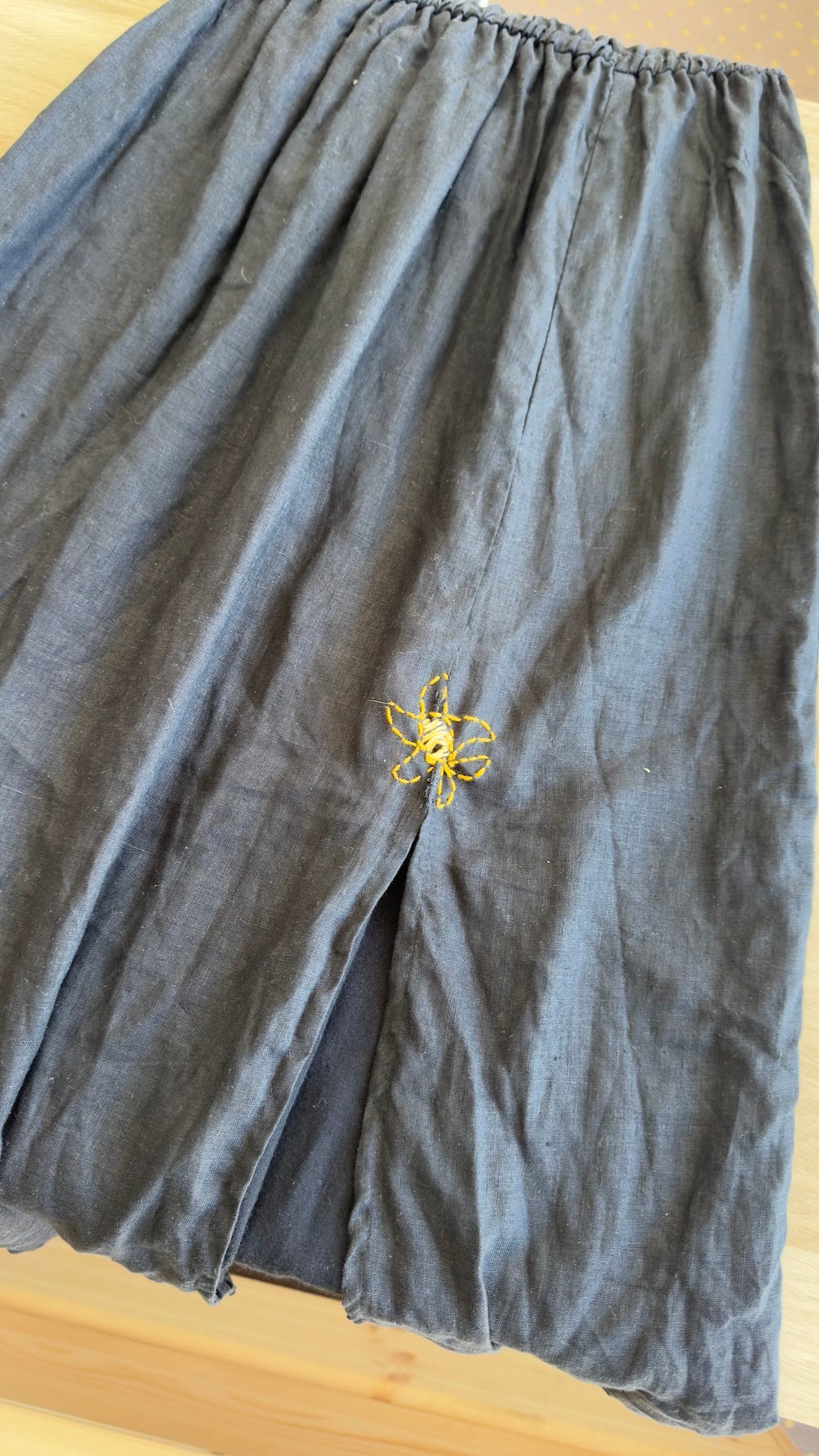
Creative mending from the repair workshop at Field School
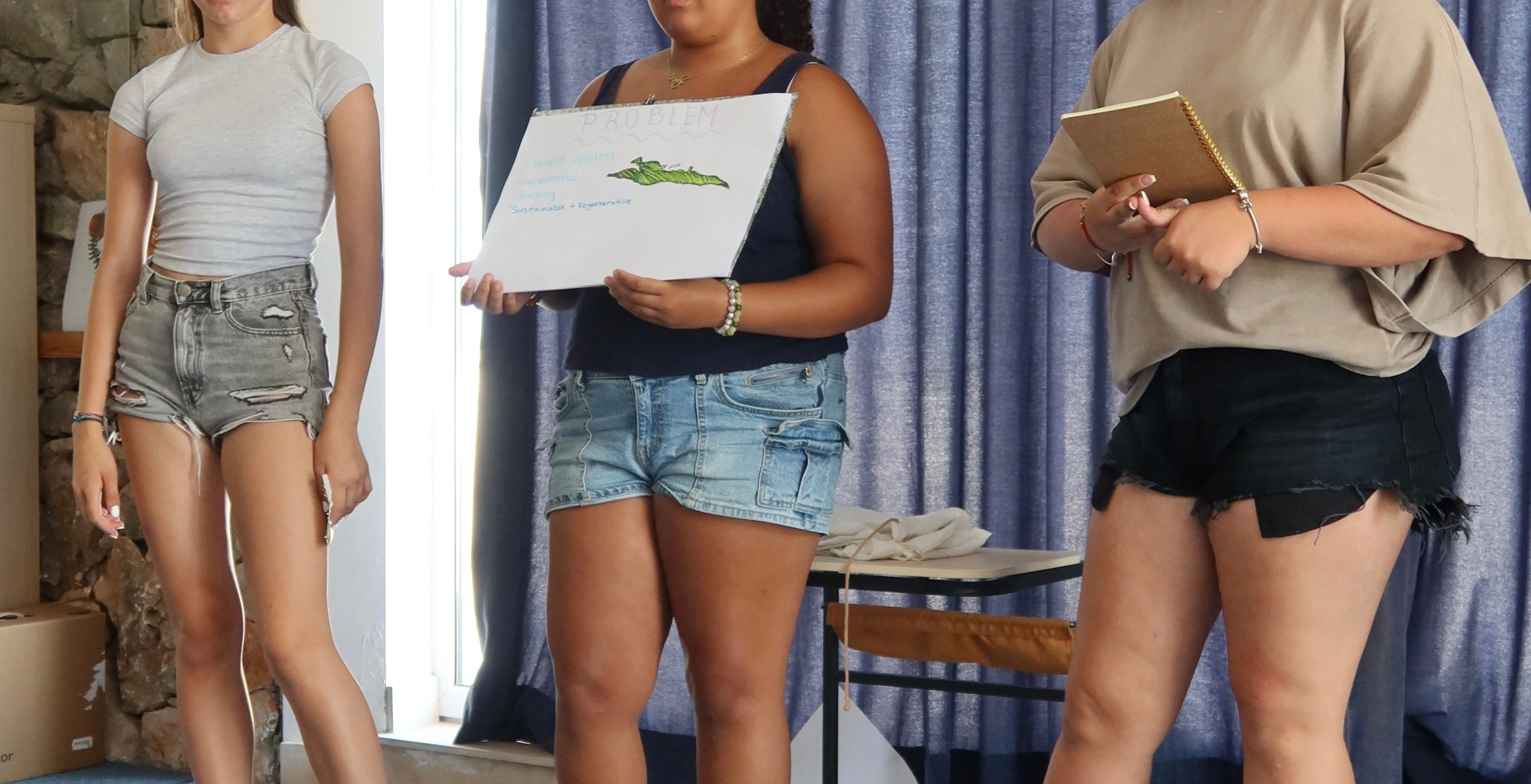
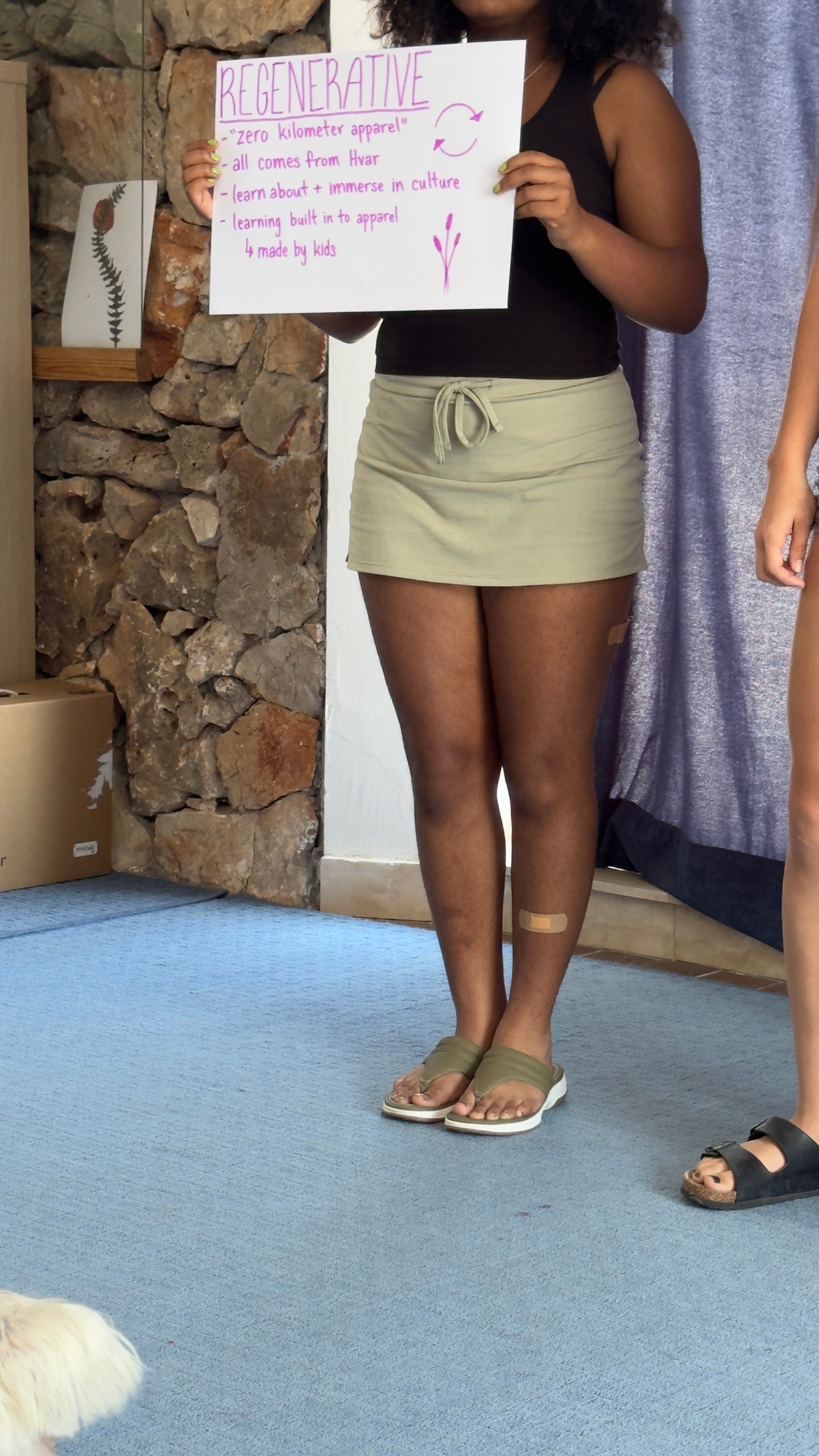
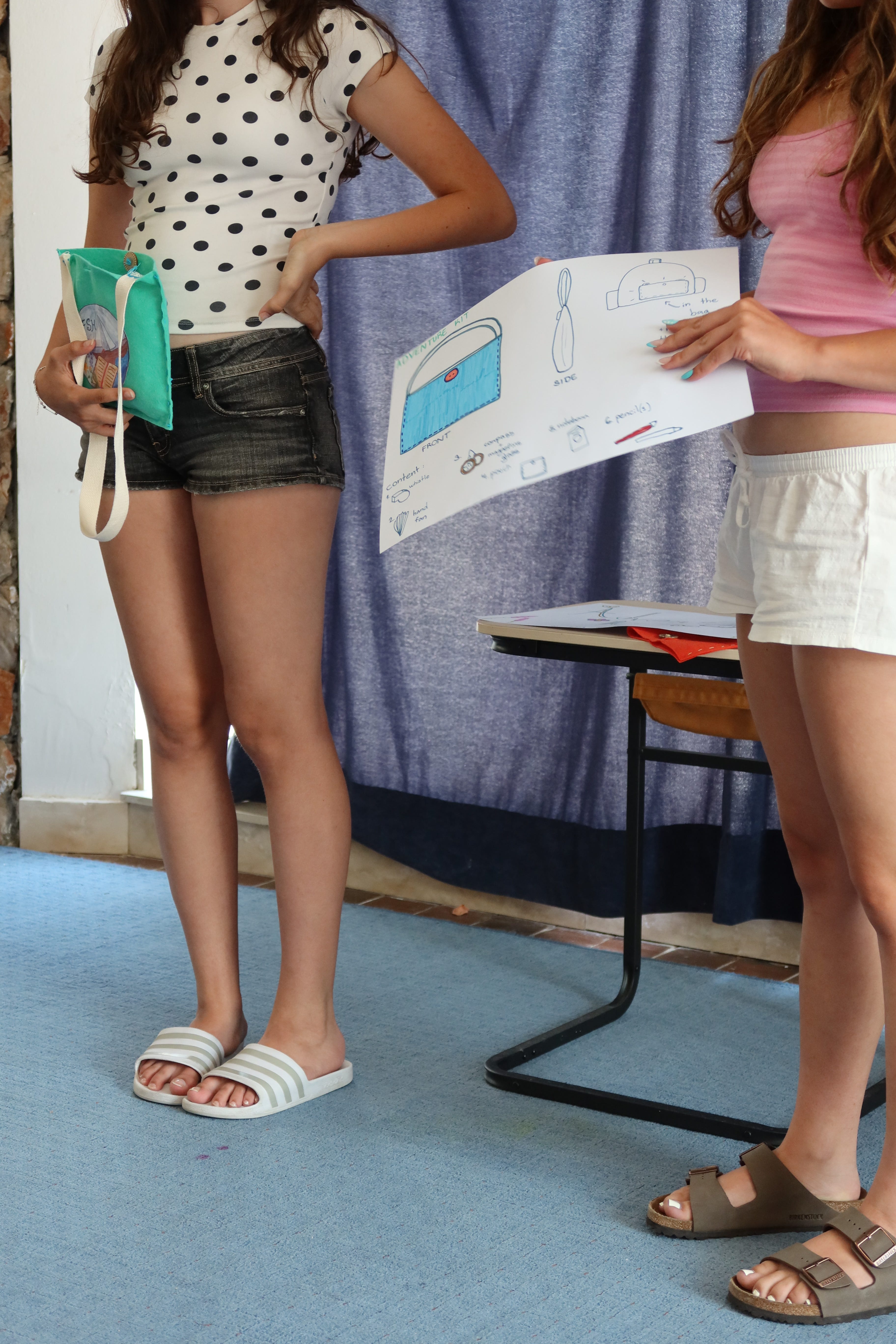
Then the fact that they were operating within their bubble of family, school and extracurricular activities, meant that their worlds were contained. They could show up authentically because every space was a safe one. So when it came to expressing themselves through their workshops and even my mending class, everyone had ideas and opinions that they weren’t afraid of asserting. I don’t pretend to know the ins and outs of each youth’s life, but the sense that a person is so attentively cared for doesn’t quite exist when you interact with grown ups.
That’s when it struck me that perhaps, as an adult, I could do that: I could reverse the influence of society, the pressures of social media and expectations from my peers for long enough to rediscover myself and my creativity. Why not? Nothing else seemed to be working and I’d been trapped in this mental state for far too long. It’s not about escaping reality but stripping things back to discover what I really want, as I fight my way out of survival mode.
It starts with removing expectations of who or what you should be and above all else, honouring who you are at present. For that, I realised that this experience of being away from my day to day was essential. None of my friends were there, my boyfriend had left the week prior and everyone was new to me. At first, I was uncomfortable with this idea but I made the conscious effort to embrace this rare circumstance.
Following that, I learnt that protecting your environment was essential. Think of this as curating a space for a child in your care (except that you are that minor). Being in a place where listening, support and community were the most important things, fostered a sense of ease. You may even call it freedom. For some, the above may look like spending two weeks at home with compassionate parents. For others, a solo trip to a place you used to love when you were growing up. For me, it also involved limiting my time spent on social media.
Then there was the element of collaboration, something that so many creatives say is important but rarely practice without commercial gain. It’s a ruthless world out there, especially for freelancers. Critically, the collaboration needed to be amongst individuals with the same goal. This is essentially a significant part of effective networking - find someone that has the same belief as you and see how far you can travel with each other. However, in a mental and emotional state where you feel lost, at the early stages of collaboration, money shouldn’t even come into the conversation. A tough feat for adults.
And its here that I’ll likely lose you. The next step requires taking things beyond the theoretical: Do something creative without caring about the consequences (obviously not referring to anything unethical). At this stage, you are purely executing. That is your only goal. There is no room for any other thought like, ‘will this make me look dumb’ or ‘is this actually a good idea?’ This is especially when you should put yourself in your teenage shoes. Maybe you were one of those kids that felt like every decision was a big deal. I certainly was. I had a ten year plan and thought that every day towards that mattered. But another 16 years later and in my 30’s, I acknowledge that this belief was more limiting than it was strategic. In 16 more years, I’ll be 50. I’ll probably look back on this and think: you had time.
This could look like doubling down on that business idea that just won’t leave the back of your head. Writing one random paragraph of that story that you dreamt up five years ago and thought could be a great movie one day. And if it helps, recruit your friends to do it too. Treat it as a weekend activity. Not to dismiss the significance of your idea but to allow free play back into your process. And if we find that we don’t like it at all - maybe it’s not aligned to who you really are and its an idea borne out of necessity. These are valid and can be revisited, but not conducive to reconnecting with your sense of agency.
How to reconnect with your teenage self
Schedule a block of time or make a regular date to detach from your day to day. It helps if you can do this alone.
Muting and archiving conversations with people who you find difficult to respond to and logging off social media for a week or two are some simple ways to protect your environment.
Write down 9 ideas you would love to try as a 16 year old, no matter how small or crazy they seem. Choose one to start with.
Find supportive friends who’d help i.e. if you want to start a brand, reach out to someone who knows about social media or websites and is willing to take you through it step by step. I did this with a designer I met during the fellowship and we planned her social communications strategy for the year over coffee.
Do the ‘thing’ as if it were a weekend project. A mini version of it, so to speak. Don’t assess it or show it to anyone yet. I.e. if you want to exhibit your work at a gallery but you’re new to photography, go out and take photos. Edit your favourites, print them and make yourself a gallery wall. It’s important to finish the task and if you struggle with completion, make the project even smaller.
There’s no need to see any attempt as failure. It would be hard to imagine anyone looking back on the first time they drew a dog and think, ‘that’s shit’, what an idiot’. The first, second and tenth time we do anything, it’ll look or read exactly like the first, second and tenth time we’ve done it. That’s the point.
Reflect
Which part of that experience made you the most uncomfortable?
Which part felt like a waste of time? What does that tell you about your priorities now? Do you want to have those values?
Which of your friends did you reach out to and would you do so again?
Did you enjoy your teenage project? If so, do you want to expand on it or move onto something else?
During one of the last dinners with the girls, their teachers asked the fellows to participate in an exercise. We were asked to share what life was like when we were 16. I’m not ashamed to talk about my childhood. A lot of the tough stuff is published in my book, where I use it to reflect on how those experiences formed my relationship with clothing. My hesitation here was how dark these memories were. I considered sharing a more PR-friendly version. A more palatable and diluted series of events that wouldn’t make the students look at me with pity or worse, disappointment.
But as I got up to speak at the table, I couldn’t follow any of the points I tried to remember. We had bonded over makeovers, crochet, sewing classes, iced coffees and surprise picnics. So I told them as much as you could in a snapshot of 2-3 minutes: how I had a difficult home life but I grew up privileged. How I moved high schools three times but I was a scholar. How I knew I was depressed but didn’t have the vocabulary for it. How I had no friends.
To close, we were asked what that 16 year old girl would think about us today. I reflected on how tough things had been for the last 12 months. I was unhappy before I arrived on that island. But in the throes of reliving my teenage insecurities, I couldn’t plan the words that escaped me. “I have a lot of compassion for that 16 year old girl now, I can see that she was only trying to survive”.
Whenever I could force my eyes to look up and meet theirs, I saw encouragement. They smiled at me, like they could see that that was the case too. With all the belief and acceptance I had, I concluded: “I think 16 year old me would be surprised at what our life is now… but she would be so happy. It’s more than she could imagine.” And it will continue to be.